How to Choose an Authentic Name You Can Actually Pronounce
24. März 2026
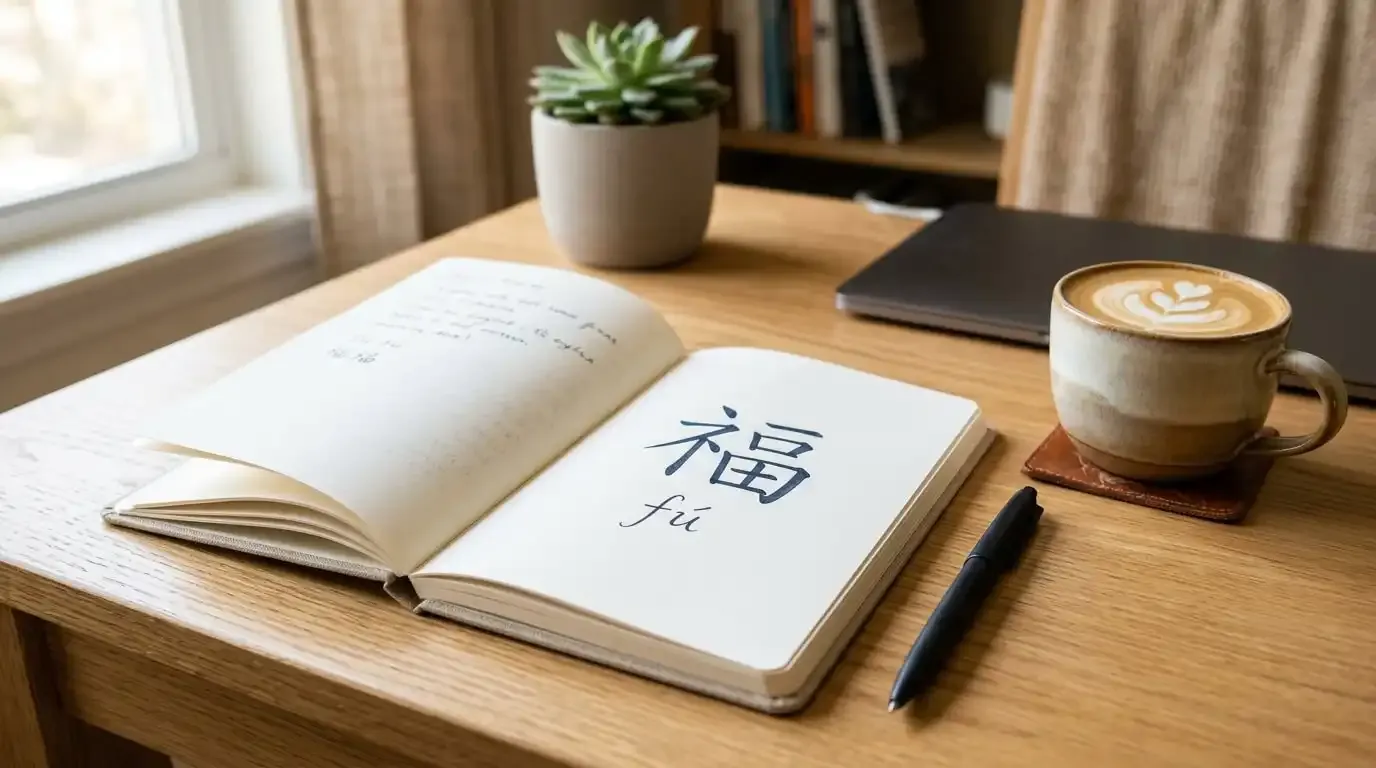
Before mastering the pronunciation, it helps to understand the basic structure of a Chinese name, including surnames and generational characters.
Let’s be completely honest for a second. You want a Chinese name. You know it’s essential for doing business in Shanghai, navigating social circles in Beijing, or simply showing genuine respect for a culture you admire.
But deep down, there is a very real, very sweaty fear holding you back:
"What if I butcher the pronunciation and accidentally call my CEO a horse?"
It’s the classic Chinese learning anecdote (and yes, depending on the tone, ma can mean mother, hemp, horse, or scold). The paralyzing fear of mispronouncing your own name and embarrassing yourself in a boardroom or at a dinner party is the number one reason many foreigners stick to awkward, direct English translations, or worse, avoid introducing themselves in Chinese entirely.
But here is the industry secret that language apps won't tell you: You do not need to be fluent in Mandarin to have a beautiful, authentic Chinese name. You just need a strategic approach. You need to know how to navigate the "Pinyin traps," choose characters that are naturally friendly to an English speaker's tongue, and master a simple psychological trick for tones.
Here is your definitive, stress-free guide to finding an authentic Chinese name you can actually pronounce with total confidence.
1. The Pinyin Illusion: Avoid the Traps (X, Q, C, ZH, and R)
Pinyin is the official romanization system used to write Chinese sounds using the English alphabet. Because it looks like English, your brain assumes it sounds like English. This is a massive trap.
Many letters in Pinyin sound absolutely nothing like their Western counterparts. If you blindly choose a name heavily featuring these letters, you will constantly have to correct people back home, and you might even struggle to introduce yourself in China.
If you are worried about pronunciation, your first rule of thumb is to avoid names heavily reliant on these five letters:
X: It’s not "Ecks." It sounds like a sharp, airy "Sh" (like the sh in she, but with your tongue pressed lower). If your name is Xia (夏), Westerners will call you "Zia."
Q: It’s not a "K" or a "Qu" sound. It sounds like a hard, breathy "Chee" (like in cheese). The name Qiang (强) is pronounced "Chee-ang," not "Kwang."
C: It’s not a "K" or an "S". It sounds like "Ts" (like the end of the word cats).
Zh: This one requires acrobatics. It sounds a bit like a "J" (like in jump), but you have to curl your tongue to the roof of your mouth.
R: The Mandarin "R" is notorious. It’s a bizarre hybrid between the English "R" and the French "J" (like in Jacques). The word Ren (Person) sounds almost like "Urr-jen."
The Golden Rule: When browsing our name directory or using a free Chinese name generator, look for names built on safe, universally recognized consonants: M, L, F, D, T, N, B, P, K, G, S.
.webp)
2. The "Phonetic Bridge": Names That Work Effortlessly in Both Worlds
The smartest strategy for someone who doesn't speak Chinese is to adopt a "Phonetic Bridge" name.
These are authentic, historically rich Chinese characters that just happen to align perfectly with familiar English syllables. You get the profound cultural weight of a native name, combined with the effortless pronunciation of your native tongue. No tongue gymnastics required.
Here is how you execute this strategy for some of the most popular Western names.
Phonetic Bridges for Women
Instead of forcing a difficult translation, look for elegant characters that create a natural, flowing rhythm.
Emma: The standard translation is Ai Ma (艾玛). It sounds exactly like Emma. However, to elevate it from a basic translation to a beautiful name, a professional might suggest Man (曼), meaning graceful, combined with Ya (雅), meaning elegant. Man Ya is incredibly easy to say and sounds deeply sophisticated.
Anya: Can be beautifully translated as An Ya (安雅). An means peace and safety, and Ya means elegance. It sounds almost identical to "Anya" in English, yet it reads like poetry to a Chinese native.
Sarah: Avoid the clunky standard translation Sa La. Instead, look at Sha Ruo (莎若). Sha is a sedge grass (often used in elegant names), and Ruo means "as if" or "like." It flows beautifully: "Sha-Ruo."
Chloe: Instead of Ke Luo Yi, try Ke Li (可丽). Ke means capable or permitting, and Li means beautiful. It’s a crisp, two-syllable name that an English speaker can master in seconds.
Phonetic Bridges for Men
Men’s names often aim for characters that project strength, reliability, and clear articulation.
David: The internet will tell you David is Da Wei (大卫). The problem? Da Wei literally translates to "Big Guard." It lacks ambition. The expert upgrade? Keep the easy pronunciation but change the characters to Da Wei (达伟). Da means to reach or achieve, and Wei means greatness. Same easy pronunciation, 100x better meaning.
Lucas: Translated literally, it’s a mouthful: Lu Ka Si. Instead, use Lu Kai (陆凯). Lu is a strong surname meaning land, and Kai means victory or triumph. "Lu-Kai" is punchy, powerful, and requires zero effort to pronounce.
Liam: Can be translated seamlessly as Li An (理安). Li implies logic, reason, or managing affairs, and An implies peace and stability. A perfect, easily pronounceable name for a finance or operations executive.
Leo / Leon: Look no further than Li Ao (立傲). Li means to stand firm, and Ao means proud. "Standing proud." It sounds like Leo, but carries massive executive energy.
3. The Surnames: Anchor Yourself Safely
In Chinese culture, the surname comes first. If your given name is perfectly pronounceable but you attach it to a terrifyingly difficult surname like Zhuang (庄) or Xie (谢), you’ve defeated the purpose.
Pick a common, single-syllable surname that uses safe consonants. Not only are these easier to say, but common surnames actually build trust faster in China because they sound instantly familiar.
The Safest Surnames for English Speakers:
Ma (马): Means horse. Very common, impossible to mispronounce.
Li (李): Means plum. The most common surname in the world. Easy.
Wang (王): Means king. Simple and authoritative.
Gao (高): Means tall/high. Pronounced exactly like the English word "cow," but with a G.
Lin (林): Means forest. Sounds exactly like the "Lynn" in Brooklyn.
4. The "Cheat Code" for Chinese Tones
Okay, so you’ve picked a bulletproof name like Lin An Ya or Ma Da Wei. But what about the tones?
Mandarin has four distinct tones, and this is where the panic usually sets in. Westerners think they have to sing their names. You don't. You actually use these exact tones in everyday English to express emotion.
Here is your psychological cheat code to master your specific name’s tones:
The 1st Tone (Flat & High): Think of a robot, or how you say "Ummmm" when you are thinking. The pitch stays completely flat.
The 2nd Tone (Rising): Think of asking a question when you didn't hear someone. "What?!" Your voice naturally goes up. That’s the second tone.
The 3rd Tone (Falling then Rising): Think of a skeptical hesitation. "Weeeell..." Your voice drops low and then bounces back up.
The 4th Tone (Sharp & Falling): Think of giving a firm, angry command. "Stop!" or "No!" Your voice drops sharply and abruptly.
When you get your Chinese name, look at the Pinyin marks (e.g., Lǐ). Then, assign the "English emotion" to that character. You aren't learning a new musical system; you are just acting out an emotion you already know.
.webp)
5. The Ultimate "Smartphone Test"
Before you print 500 business cards with your new name, how do you know if you are actually pronouncing it right? You don't need to hire a tutor just to check. You already have a native Chinese listener in your pocket: your smartphone.
Switch your phone's keyboard or Siri/Google Assistant language to Mandarin Chinese.
Open a blank note.
Hit the microphone button for voice dictation.
Say your new Chinese name out loud.
If the exact characters you chose pop up on the screen, congratulations. Your pronunciation is officially good enough for a native AI to understand you. You are ready for the boardroom.
Claim Your Name with Total Confidence
Your Chinese name should be a powerful tool to bridge a cultural gap, not a source of social anxiety. You absolutely do not have to settle for a weird, meaningless computer translation just because you can't roll your R's or pronounce a Pinyin "Q."
You can have a name that makes native speakers nod in genuine respect, while still rolling comfortably off your own tongue.
If you want to explore names that are guaranteed to be both culturally profound and phonetically safe, browse our curated A-Z Chinese Name Directory. We’ve done the heavy lifting of filtering out the awkward translations.
Or, if you want a name that is completely stress-tested for your specific language background—a name you can say smoothly in your sleep—let our native cultural experts craft one for you through our Premium Naming Service. We will not only provide the cultural breakdown of the characters, but also the exact phonetic "cheat codes" so you can introduce yourself to your next Chinese client with 100% confidence.